


Article: Ceiling Fans for Sloped Ceilings: How to Choose the Right Fan and Downrod
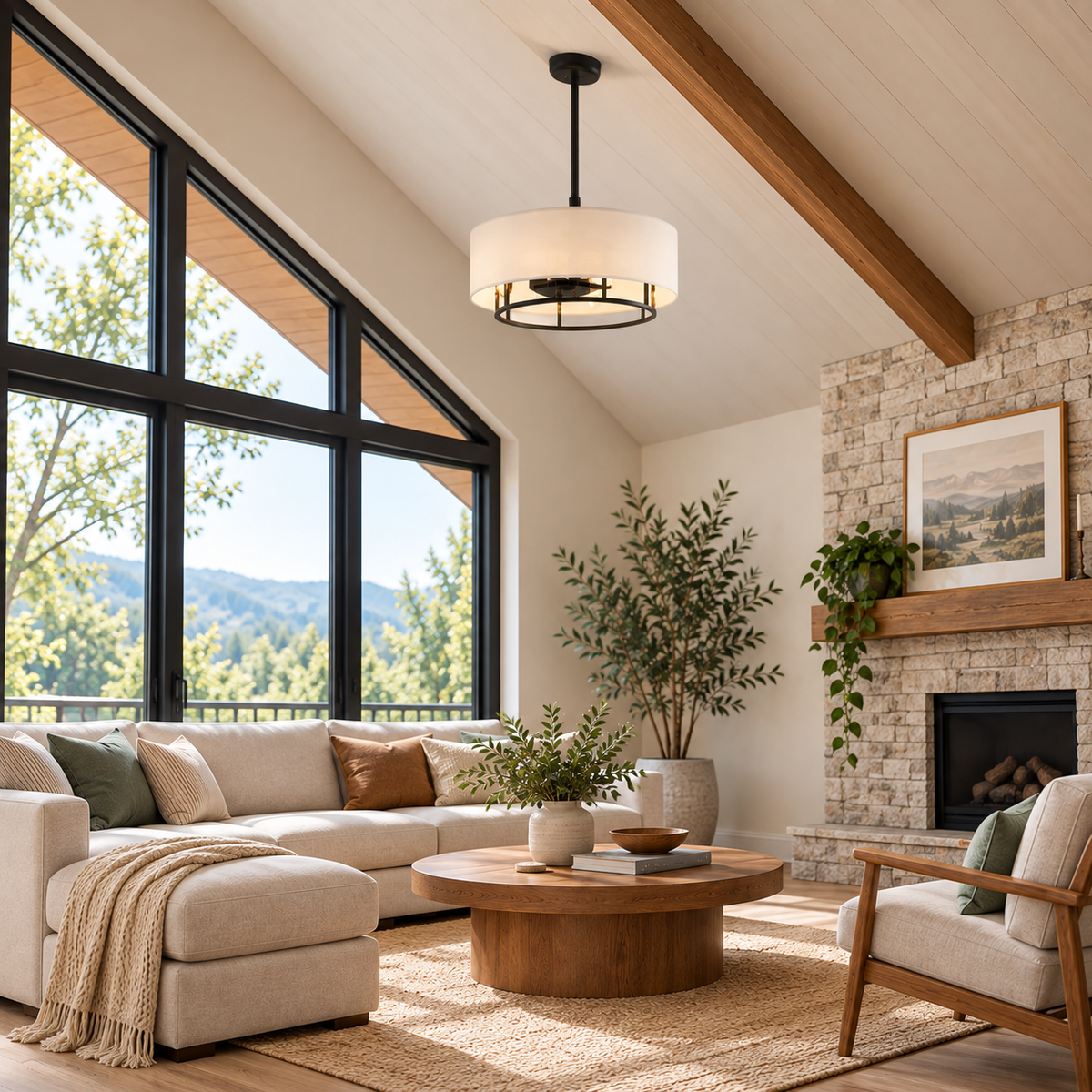
Ceiling Fans for Sloped Ceilings: How to Choose the Right Fan and Downrod
Vaulted and angled ceilings can make a room feel larger, brighter, and more architectural — but they can also make choosing a ceiling fan a little more complicated.
If you're shopping for ceiling fans for sloped ceilings, there are two important questions to answer before installation:
Is the ceiling fan compatible with your ceiling's slope? And what length downrod do you need?
The right combination of ceiling fan, mounting hardware, and downrod allows the fan to hang level while maintaining proper clearance from the ceiling, walls, and floor.
At Arranmore Lighting & Fans, several of our ceiling fans and fandeliers can be installed on sloped or vaulted ceilings using either their standard mounting hardware or an optional sloped ceiling adapter.
Here's what you need to know before choosing your fan.
Step 1: Determine Your Ceiling Slope
Not every sloped ceiling is the same.
A gently angled ceiling may work with the mounting hardware included with your ceiling fan, while a steeper vaulted ceiling may require a sloped ceiling adapter.
The ceiling slope is measured in degrees. The greater the angle, the steeper the ceiling.
Before purchasing your fan, determine the approximate slope of your ceiling and compare it with the maximum slope supported by the fan's standard mounting hardware.
For Arranmore ceiling fans, the requirements vary by model.
Arranmore Sloped Ceiling Compatibility
| Fan Type | Standard Hardware | Optional Sloped Ceiling Adapter |
|---|---|---|
| Arranmore Fandeliers | Up to 15.5° | Up to 45° |
| Ravian® Ceiling Fans | Up to 19° | Up to 45° |
| Orca H₂O® Ceiling Fans | Standard mounting hardware is not designed for sloped-ceiling installation | Up to 30° with Orca H₂O® adapter |
For compatible Arranmore fandeliers and Ravian® ceiling fans, our optional Sloped Ceiling Adapter allows installation on ceilings with slopes up to 45 degrees.
The extra-large Orca H₂O® collection uses its own dedicated Sloped Ceiling Adapter, designed specifically for Orca H₂O® fans and ceiling slopes up to 30 degrees.
Step 2: Know When You Need a Sloped Ceiling Adapter
One of the most common questions when shopping for a ceiling fan for a vaulted ceiling is whether special mounting hardware is required.
The answer depends on the angle.
If the ceiling falls within the slope supported by your fan's included hardware, an additional adapter isn't necessary.
For example, Arranmore fandeliers accommodate slopes up to 15.5° with their standard hardware, while the Ravian® accommodates slopes up to 19°.
For steeper ceilings, the mounting system needs additional articulation so the downrod can hang vertically even though the mounting surface is angled.
That's where a sloped ceiling adapter comes in.
Our Sloped Ceiling Adapter for compatible Ravian® and Fandelier models accommodates ceiling slopes up to 45° and is designed to maintain proper fan alignment on angled and vaulted ceilings. It is available in five housing finishes to coordinate with compatible fans.


Step 3: Choose the Right Downrod Length
Slope compatibility is only part of the equation.
Once you've determined how the fan will attach to the ceiling, you'll also need to consider downrod length.
A downrod is the metal rod that connects a ceiling fan's motor housing to its ceiling mounting hardware. On higher ceilings, a longer downrod lowers the fan into the room.
This is particularly important with vaulted ceilings because the mounting point may be considerably higher than the rest of the room.
As a general rule, you want your fan positioned low enough to effectively circulate air while still maintaining appropriate clearance from the floor and surrounding walls.
Your ideal downrod length will depend on:
- Ceiling height
- Ceiling slope
- Fan blade span
- Distance from nearby walls
- Desired fan height
A room with a moderately sloped 10-foot ceiling, for example, may need much less additional downrod length than a great room with a dramatic 16-foot vaulted ceiling.
If you're unsure which length you need, visit our Ceiling Fan Downrod Size Guide before choosing your extension downrod.
Why Wall Clearance Matters on a Sloped Ceiling
There's another measurement that's easy to overlook: the distance between the fan and the nearest wall or angled portion of the ceiling.
On a flat ceiling, the blades generally have plenty of open space around them. On a vaulted ceiling, one side of the fan may be considerably closer to the ceiling or wall.
That's why choosing the correct downrod isn't just about bringing the fan closer to the living space.
It also helps provide adequate clearance around the fan.
For the installations shown in our sloped-ceiling diagrams, maintain a minimum distance of 18 inches from the fan to any wall and a minimum distance of 7 feet from the floor to the fan.
Always follow the installation instructions and clearance requirements provided for your specific fan.
Can You Put a Fandelier on a Sloped Ceiling?
Yes — compatible Arranmore fandeliers can be installed on sloped ceilings.
With their included standard mounting hardware, our fandeliers accommodate ceiling slopes up to 15.5 degrees.
That makes them an especially interesting option for bedrooms, dining areas, kitchens, offices, and other spaces where you want both decorative lighting and air circulation without the visual scale of a traditional ceiling fan.
For ceilings with slopes greater than 15.5°, compatible models can be paired with the Arranmore Sloped Ceiling Adapter, increasing compatibility to slopes up to 45 degrees. The adapter is designed specifically for compatible Arranmore Ravian® and Fandelier models.

This allows you to use a decorative fandelier even in rooms with architectural ceiling lines where a standard flat-ceiling installation isn't possible.
Can a Ravian® Ceiling Fan Be Installed on a Sloped Ceiling?
Yes.
The Arranmore Ravian® ceiling fan accommodates slopes up to 19 degrees using its standard hardware.
For a steeper vaulted or angled ceiling, the compatible Arranmore Sloped Ceiling Adapter extends installation capability to ceiling slopes up to 45 degrees.
Because Ravian® is available in multiple blade spans, it's particularly well suited to spaces where vaulted ceilings are common, such as living rooms, great rooms, open-concept spaces, and covered outdoor areas.
When installing a Ravian® on a higher vaulted ceiling, remember to consider both the ceiling angle and ceiling height when choosing your downrod.

What About Orca H₂O® on a Sloped Ceiling?
The Orca H₂O® requires a different approach.
Its standard mounting configuration is not intended for sloped-ceiling installation. If you're installing an Orca H₂O® on an angled or vaulted ceiling, you'll need the dedicated Sloped Ceiling Adapter for Orca H₂O® Ceiling Fans
This heavy-duty adapter is engineered specifically for the Orca H₂O® collection and accommodates ceiling slopes up to 30 degrees.
Because Orca H₂O® fans are extra-large ceiling fans, proper mounting, clearance, downrod selection, and installation are especially important. Professional installation is recommended for the Orca adapter.

Sloped Ceiling vs. Vaulted Ceiling: Is There a Difference?
You'll often see the terms sloped ceiling, angled ceiling, cathedral ceiling, and vaulted ceiling used when shopping for ceiling fans.
While the architectural designs can differ, the important consideration for your ceiling fan is the angle of the mounting surface where the fan will be installed.
A ceiling fan installed on an angled surface needs mounting hardware capable of accommodating that angle while allowing the downrod and fan itself to hang vertically.
That's why you shouldn't choose a ceiling fan based on ceiling height alone.
You need to consider both:
Ceiling height + ceiling slope.
Common Mistakes When Choosing Ceiling Fans for Sloped Ceilings
Choosing a fan for a vaulted or angled ceiling isn't difficult, but a few common mistakes can create problems during installation.
1. Assuming every downrod fan works on every slope
A fan may use a downrod and still have a maximum ceiling angle. Always check the manufacturer's slope specifications.
2. Measuring ceiling height but not ceiling angle
A 12-foot ceiling doesn't tell you how steep the mounting surface is. Measure both before choosing your mounting configuration.
3. Forgetting about blade clearance
As the ceiling angle increases, one side of the fan moves closer to the ceiling or wall. Make sure your installation provides adequate clearance.
4. Choosing the sloped ceiling adapter but forgetting the downrod
The adapter solves the mounting-angle problem. The downrod determines how far the fan drops into the room. On tall vaulted ceilings, you may need both.
5. Using the wrong sloped ceiling adapter
Compatibility matters. Arranmore's adapter for Ravian® and compatible fandeliers supports slopes up to 45°, while the Orca H₂O® uses its own dedicated heavy-duty adapter for slopes up to 30°.
Final Thoughts: Choosing a Ceiling Fan for a Sloped Ceiling
So, what should you look for when choosing ceiling fans for sloped ceilings?
Start with three measurements:
Your ceiling slope, your ceiling height, and the available clearance around the fan.
Then choose a ceiling fan with mounting hardware designed for your ceiling angle. For steeper slopes, determine whether a compatible sloped ceiling adapter is available. Finally, select the appropriate downrod length so the fan hangs at the proper height and has enough clearance from surrounding walls.
For Arranmore Lighting & Fans:
Fandeliers: Standard hardware up to 15.5°; optional adapter up to 45°
Ravian®: Standard hardware up to 19°; optional adapter up to 45°.®
Orca H₂O®: Dedicated sloped ceiling adapter required for sloped installations; accommodates slopes up to 30°.
With the right combination of fan, downrod, and mounting hardware, a vaulted ceiling doesn't have to limit your ceiling fan options. Explore our Ceiling Fans, Fandeliers, Fan Extension Rods, and Sloped Ceiling Adapters to find the right configuration for your space.



Leave a comment
This site is protected by hCaptcha and the hCaptcha Privacy Policy and Terms of Service apply.